
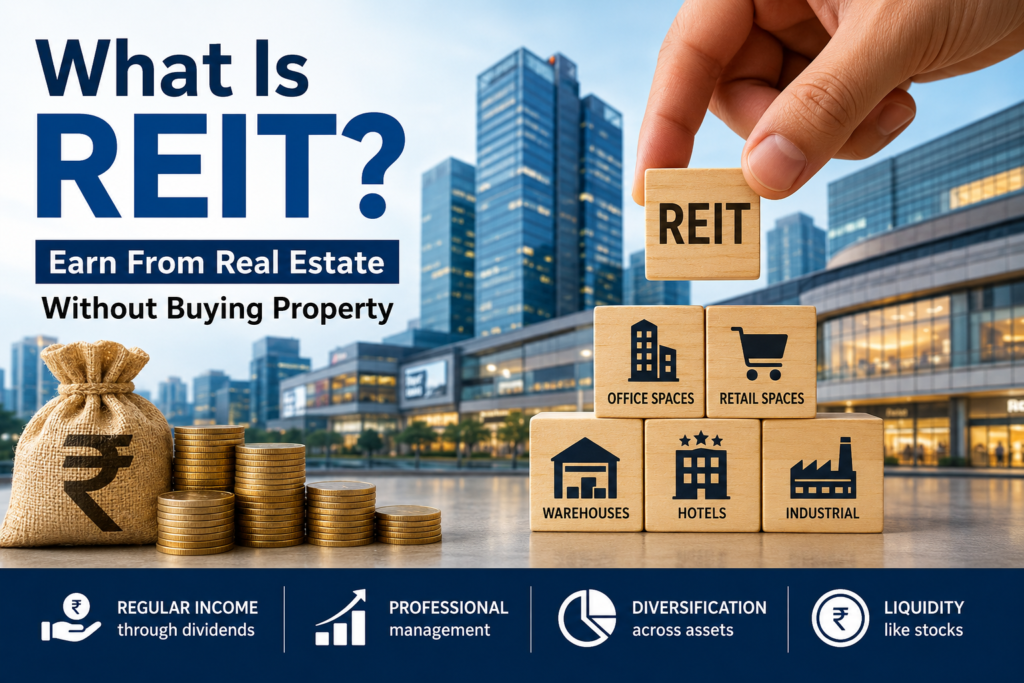
What Is REIT? How Investors Earn From Real Estate Without Buying Property – A Complete Guide to Real Estate Investment Trusts (REITs).
Discover everything about REITs (Real Estate Investment Trusts), how they work, types of REITs, benefits, taxation, risks, Indian REIT market, and how investors can earn passive income from real estate without buying property. Complete investor guide by Intellex Strategic Consulting Pvt Ltd
Introduction
Real estate has traditionally been considered one of the safest and most rewarding investment classes in the world. For decades, investors have purchased residential apartments, commercial offices, warehouses, retail shops, and land parcels to create wealth and generate rental income.
However, direct real estate investment comes with several practical challenges:
- Large capital requirements
- High registration and stamp duty costs
- Property maintenance responsibilities
- Tenant management issues
- Liquidity constraints
- Legal and compliance complications
- Difficulty in diversification
Many investors dream of earning rental income from premium commercial properties such as corporate office towers, malls, IT parks, hotels, and logistics parks but cannot afford to buy such large assets individually.
This is where REITs (Real Estate Investment Trusts) have transformed the investment landscape.
A REIT enables ordinary investors to participate in large-scale income-generating real estate projects without directly purchasing physical property. Investors can buy small units of a REIT just like shares listed on a stock exchange and earn income through rental yields, property appreciation, and dividends.
Globally, REITs have become a multi-trillion-dollar investment sector, especially in countries like the United States, Singapore, Australia, Japan, Canada, and increasingly India.
In this detailed guide, we will explain everything investors need to know about REITs, including:
- What REITs are
- How REITs work
- Types of REITs
- How investors earn returns
- Advantages and risks
- REIT taxation
- Indian REIT market overview
- REIT vs physical real estate
- Who should invest in REITs
- Future opportunities in India
What Is a REIT?
A REIT (Real Estate Investment Trust) is a company or trust that owns, operates, finances, or manages income-producing real estate assets.
These assets typically include:
- Commercial office buildings
- Shopping malls
- Warehouses
- Hospitals
- Hotels
- Data centers
- Industrial parks
- Residential rental properties
- Infrastructure-linked properties
Instead of buying a property directly, investors purchase units or shares of the REIT.
The REIT collects rental income from tenants occupying its properties and distributes a significant portion of the profits to investors in the form of dividends or distributions.
In simple words:
A REIT allows investors to earn from real estate in the same way mutual funds allow investors to participate in stock markets.
The Origin and Evolution of REITs
REITs were first introduced in the United States in 1960 to democratize access to commercial real estate investments.
Before REITs, only wealthy individuals and institutions could invest in premium commercial properties.
The REIT structure enabled small investors to collectively invest in large-scale real estate assets while enjoying professional management and regular income distribution.
Today, REITs are among the most important investment vehicles globally.
The Indian REIT market is relatively new but growing rapidly with strong participation from institutional investors, retail investors, pension funds, and foreign investors.
How Does a REIT Work?
The functioning of a REIT can be understood through a simple structure.
Step 1: Acquisition of Real Estate Assets
The REIT acquires or develops income-generating properties such as:
- Corporate office spaces
- Business parks
- Warehousing hubs
- Shopping complexes
- Hotels
Step 2: Leasing and Rental Income
The properties are leased to tenants including:
- Multinational corporations
- IT companies
- Retail brands
- Financial institutions
- Logistics companies
These tenants pay rent regularly.
Step 3: Income Collection
The REIT collects rental income and other property-related earnings.
Step 4: Expense Management
Operational expenses are deducted, including:
- Property maintenance
- Facility management
- Taxes
- Insurance
- Loan interest
- Administrative costs
Step 5: Distribution to Investors
A major portion of profits is distributed to unit holders as:
- Dividends
- Interest income
- Capital repayment components
In many countries including India, REIT regulations mandate high distribution ratios to ensure investors receive regular income.
Key Features of REITs
1. Professionally Managed
REITs are managed by experienced real estate professionals.
2. Regular Income Distribution
REITs are designed to provide stable cash flows through rental income.
3. Stock Exchange Listing
Most REITs are listed on stock exchanges, providing liquidity.
4. Diversification
Investors get exposure to multiple properties through a single investment.
5. Lower Entry Barrier
Investors can start with relatively small investment amounts.
Types of REITs
1. Equity REITs
These REITs own and operate income-generating properties.
Revenue primarily comes from:
- Rental income
- Lease renewals
- Property appreciation
This is the most common type of REIT.
2. Mortgage REITs (mREITs)
Mortgage REITs invest in:
- Property mortgages
- Housing finance instruments
- Real estate debt securities
Income is generated through interest earnings.
3. Hybrid REITs
These combine features of both:
- Equity REITs
- Mortgage REITs
Sector-Based REIT Categories
Office REITs
Invest in:
- IT parks
- Corporate towers
- Business centers
Retail REITs
Own:
- Shopping malls
- Retail centers
- Entertainment complexes
Residential REITs
Focus on rental housing properties.
Hospitality REITs
Invest in:
- Hotels
- Resorts
- Serviced apartments
Healthcare REITs
Own:
- Hospitals
- Medical offices
- Diagnostic centers
Industrial and Logistics REITs
Invest in:
- Warehouses
- Logistics parks
- Industrial facilities
Data Center REITs
These are emerging globally due to digital transformation.
How Investors Earn Money From REITs
REIT investors generally earn returns from two major sources.
1. Dividend Income
The biggest attraction of REITs is regular income distribution.
Rental income collected from tenants is distributed among investors.
This creates a passive income stream.
2. Capital Appreciation
If the REIT’s property portfolio increases in value and market demand rises, unit prices may appreciate.
Investors benefit by selling units at higher prices.
Example of REIT Investment
Suppose an investor purchases REIT units worth ₹1,00,000.
The REIT owns:
- Grade-A commercial offices
- IT parks
- Warehousing assets
The REIT receives rent from major corporations.
If the annual yield is 7%:
- The investor may receive approximately ₹7,000 annually as distributions.
If the REIT unit price rises by 15% over time:
- Investment value may increase to ₹1,15,000.
Thus, the investor benefits from:
- Regular income
- Long-term capital growth
REITs in India
India formally introduced REIT regulations through SEBI.
The Indian REIT market has expanded steadily because of:
- Growing commercial real estate sector
- Institutional participation
- Increasing retail investor awareness
- Stable rental yields
- Demand for passive income assets
Indian REITs primarily focus on:
- Commercial office assets
- IT parks
- Business centers
- Corporate campuses
Regulatory Framework for REITs in India
REITs in India are regulated by the Securities and Exchange Board of India (SEBI).
Some important regulatory requirements include:
- Majority investment in completed income-generating assets
- Mandatory distribution of cash flows
- Professional management structure
- Valuation disclosures
- Stock exchange listing compliance
These regulations improve investor confidence and transparency.
Benefits of Investing in REITs
1. Passive Income Opportunity
REITs provide regular cash flow without property management hassles.
2. No Need to Buy Physical Property
Investors can participate in commercial real estate with small capital.
3. Liquidity
Unlike physical real estate, REIT units can be bought and sold on stock exchanges.
4. Diversification
A single REIT may own multiple properties across locations and sectors.
5. Professional Asset Management
Properties are managed by experts.
6. Transparency
Listed REITs follow strict disclosure norms.
7. Lower Investment Amount
Investors avoid massive upfront property costs.
8. Inflation Hedge
Rental values often rise over time, helping offset inflation.
Risks Associated With REIT Investments
Like every investment, REITs also carry certain risks.
1. Market Risk
REIT prices fluctuate with market sentiment.
2. Interest Rate Risk
Higher interest rates can reduce REIT attractiveness.
3. Vacancy Risk
If tenants vacate properties, rental income may decline.
4. Economic Slowdown
Commercial property demand may weaken during recessions.
5. Regulatory Changes
Changes in taxation or regulations can impact returns.
6. Sector-Specific Risks
For example:
- Work-from-home trends affecting office REITs
- E-commerce affecting retail malls
REIT vs Direct Real Estate Investment
| Basis | REIT | Direct Property |
|---|---|---|
| Investment Size | Low | High |
| Liquidity | High | Low |
| Diversification | Multiple properties | Usually single property |
| Management | Professional | Self-managed |
| Rental Collection | Automated | Manual |
| Legal Complexity | Lower | Higher |
| Maintenance | Not required | Required |
| Transaction Costs | Lower | Higher |
| Entry Barrier | Easy | Difficult |
REITs vs Mutual Funds
Although both pool investor money, they differ significantly.
| Basis | REIT | Mutual Fund |
|---|---|---|
| Asset Class | Real Estate | Stocks/Bonds |
| Income Source | Rent | Market returns |
| Volatility | Moderate | Varies |
| Yield Orientation | High | Depends |
| Property Ownership | Indirect | Not applicable |
Taxation of REITs in India
Tax treatment depends on the nature of income received.
1. Dividend Income
May be taxable depending on structure and applicable laws.
2. Interest Income
Generally taxable in the hands of investors.
3. Capital Gains
Capital gains taxation depends on:
- Holding period
- Type of gains
- Applicable tax laws
Since taxation rules evolve regularly, investors should seek professional tax advice before investing.
Factors to Evaluate Before Investing in a REIT
1. Quality of Properties
Premium Grade-A assets generally perform better.
2. Occupancy Levels
Higher occupancy improves income stability.
3. Tenant Profile
Long-term leases with reputed companies reduce risk.
4. Rental Yield
Investors should compare yields with other investments.
5. Debt Levels
Excessive borrowing may increase financial risk.
6. Management Quality
Experienced management improves operational efficiency.
7. Geographic Diversification
Properties across multiple cities reduce concentration risk.
Who Should Invest in REITs?
REITs may be suitable for:
Salaried Individuals
Seeking passive income diversification.
Retired Investors
Looking for periodic income.
Young Investors
Wanting real estate exposure without buying property.
Conservative Investors
Seeking relatively stable cash flows.
Portfolio Diversifiers
Adding real estate exposure to investment portfolios.
Advantages of Indian REIT Market
India presents strong growth potential due to:
- Expanding urbanization
- Corporate office demand
- Growth in logistics and warehousing
- Rising startup ecosystem
- Infrastructure expansion
- Increasing foreign investment
India’s commercial real estate sector continues to attract global institutional capital.
The Future of REITs in India
The future of REITs in India appears highly promising.
Emerging sectors include:
- Warehousing REITs
- Data center REITs
- Healthcare REITs
- Hospitality REITs
- Infrastructure-linked real estate assets
As financial literacy improves, REITs may become a mainstream investment product among Indian retail investors.
Common Misconceptions About REITs
“REITs Are Only for Rich Investors”
False. REITs enable small-ticket participation.
“REITs Are Risk-Free”
False. REITs are market-linked investments.
“REITs Only Invest in Offices”
False. REITs cover multiple real estate sectors.
“REITs Guarantee Returns”
False. Returns depend on property performance and market conditions.
Important Due Diligence Before Investing
Before investing, investors should review:
- Financial statements
- Occupancy reports
- Rental growth trends
- Debt obligations
- Asset valuation reports
- Sponsor credibility
- Historical distributions
Professional financial and tax guidance is highly recommended.
How to Invest in REITs in India
Investors can purchase listed REIT units through:
- Stock brokers
- Demat accounts
- Trading platforms
The process is similar to buying shares.
Why REITs Are Becoming Popular Globally
REITs are gaining popularity because modern investors increasingly seek:
- Passive income
- Diversification
- Liquidity
- Inflation protection
- Professional management
- Access to premium assets
Global pension funds, insurance companies, sovereign wealth funds, and retail investors actively invest in REITs.
Challenges Facing the REIT Industry
Despite growth opportunities, the sector faces challenges:
- Economic cycles
- Rising interest rates
- Remote work trends
- Regulatory uncertainty
- Tenant concentration risks
- Real estate valuation fluctuations
However, professionally managed REITs with diversified portfolios may navigate these risks more effectively.
Strategic Importance of REITs in Wealth Creation
REITs have become an important wealth creation tool because they combine:
- Real estate exposure
- Passive income generation
- Capital appreciation potential
- Liquidity advantages
For many investors, REITs provide a practical alternative to directly owning expensive commercial real estate.
Professional Advisory and Compliance Support for REIT Investors and Real Estate Businesses
REIT investments and real estate transactions involve multiple financial, legal, taxation, and regulatory considerations.
Professional advisory support can help investors and businesses with:
- REIT structuring
- Financial analysis
- Tax planning
- Investment evaluation
- Due diligence
- Regulatory compliance
- Corporate structuring
- Cross-border investment advisory
- Real estate transaction advisory
- Commercial property consulting
Service Provider
Intellex Strategic Consulting Pvt Ltd
WhatsApp: +91-98200-88394
Email: intellex@intellexconsulting.com
Associated Knowledge & Advisory Platforms:
Conclusion
REITs have fundamentally transformed the way investors participate in real estate markets.
Instead of requiring massive capital to purchase physical property, REITs enable investors to own a share in professionally managed, income-generating commercial real estate assets through a simple and liquid investment structure.
For investors seeking:
- Passive income
- Real estate diversification
- Liquidity
- Lower investment barriers
- Professional management
REITs offer an attractive investment avenue.
At the same time, investors must understand the associated risks, taxation aspects, market cycles, and sector-specific factors before making investment decisions.
As India’s commercial real estate ecosystem continues to mature, REITs are expected to play an increasingly important role in wealth creation, portfolio diversification, and democratization of real estate investing.
With proper financial planning, professional advisory support, and informed investment strategies, REITs can become a valuable component of long-term investment portfolios.
Intellex Strategic Consulting Pvt Ltd
More Featured Articles:
SEBI Reclassifies REITs as Equity from Jan 2026: InvITs to Remain Hybrid Under New Investment Rules
India’s REITs Surge as SEBI Reclassification Boosts Investor Confidence
The Ultimate Guide to Company Registration in Dubai 2026: Benefits, Compliance, and Costs.
The Future of Indian Real Estate: Key Recommendations to Strengthen RERA in 2026.
The Future of Affordable Housing in India: Breaking Barriers and Building Solutions.
Maharashtra’s Silicon Valley: Tata Sons to Anchor $11B “Innovation City” Near Mumbai.
Infrastructure Finance in India: Concept, Evolution, Key Players, and the Road Ahead
Why Every Startup and Growing Business Needs a Virtual CFO And Why IntellexCFO Is Your Best Partner
IntellexCFO.com – Specialized Real Estate Financing & Advisory Solutions
The Ultimate Guide to Working Capital Solutions for Growing Businesses in India (2026).